Bran Stark
A Clash of KingsBran Stark stands at the center of a transformation from injured child to emerging supernatural subject. Once a climber, hunter, and aspiring knight, he is now confined to Winterfell and to a body that will not obey him. Yet his disability does not make him passive. His memories, dreams, bond with Summer, and encounters with Jojen Reed reveal a power that both enlarges his world and threatens the identity he still wants to preserve.
Identity and Confinement
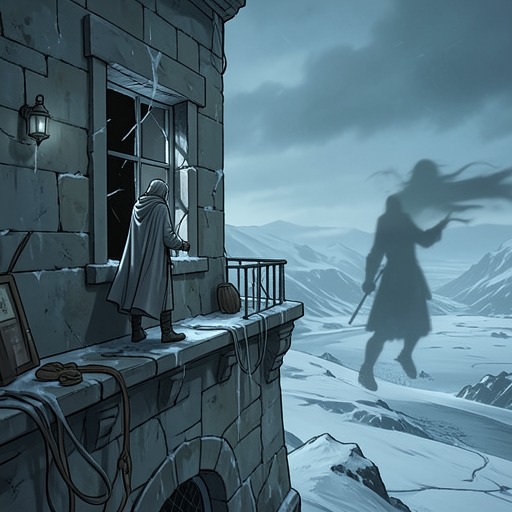
Bran’s immediate identity is defined by the fall that nearly killed him. He does not remember falling; he knows it only because others have told him that it happened, and the gap between personal memory and public account leaves the event strangely unreal. The weatherworn gargoyles above the First Keep, where the fall occurred, nevertheless provoke a tight bodily dread. His body remembers what his mind cannot recover. The consequences are concrete and total: he can no longer climb, walk, run, hunt, or fight with a wooden sword, and the dreams of knighthood that once gave shape to his future have soured.
Winterfell itself has become double-edged. Bran prefers the hard stone of the window seat to the softness of his bed because the bed makes the room feel like a cell, while the castle becomes a prison around him. From the window he can still watch candles and hearth fires kindle behind the diamond-shaped panes of tower and hall. Looking remains an ability when movement has been taken away, and the wider world continues to call from beyond the walls. He knows Winterfell intimately because he once climbed its buildings and made their rooftops secret places; that remembered freedom sharpens the present confinement rather than relieving it.
The direwolves preserve a connection between Bran’s isolated life and the lives of those beyond his room. Summer howled when Bran fell and mourned while he lay broken in bed; Shaggydog and Grey Wind joined that grief. Later, when the raven brought news of his father’s death, Summer and Shaggydog howled so fiercely that they drowned out Maester Luwin as Bran and Rickon spoke in the maester’s turret. The wolves therefore register events before Bran understands them, making his bond with them a form of knowledge as well as companionship.
Dreams and the Shape of Another Body
Bran’s dreams offer the first decisive reversal of his condition. Awake, he is trapped in a room and unable to move through the world. In one dream, however, he enters the godswood and discovers that he is walking. He understands that the experience is only a dream, but even this imagined motion is better than the truth of his bedchamber. The dream temporarily restores not merely movement but exultation: the body that fails him in waking life becomes capable of silent travel beneath the trees.
The dream’s sensory detail makes the transformation more than a symbolic wish to walk. Bran moves on four strong, swift legs, feels fallen leaves, roots, stones, and humus beneath his feet, and experiences the hot pools, rich earth, and squirrels as powerful living scents. Hunger changes with the body as well. The memory of squirrel becomes the taste of hot blood and cracking bones, while dead meat, even deer, offers no joy. The dream gives Bran access to an animal consciousness whose appetites are vivid, physical, and potentially disturbing.
Summer’s presence links this dream-state to Bran’s waking life. The wolf is not simply an external companion mourning its injured master; the wolf’s senses, grief, and hunger become part of a larger field in which Bran’s own boundaries are no longer stable. The movement that Bran cannot achieve as a boy is available through the wolf, but the price of that freedom is the pressure of another set of instincts. His recovery of agency is therefore also a confrontation with an identity he did not choose.
The Green Dream and the Winged Wolf
Jojen Reed gives Bran’s experiences a vocabulary and a danger. Maester Luwin has suggested that dreams may mean anything or nothing, but Meera Reed distinguishes ordinary dreams from green dreams. Jojen’s own vision is specific: a winged wolf is bound to the earth by grey stone chains, while a crow with three eyes tries to peck through them and can only chip the stone. Because the dream is green, Jojen says he knows it is true.
The image gathers Bran’s condition into a single figure. The wolf evokes the power and embodied freedom associated with Summer, while the wings suggest a capacity beyond ordinary wolf-dreaming. The grey stone chains correspond to Bran’s confinement, his damaged body, and the walls of Winterfell that have become his prison. The three-eyed crow appears as an agent attempting to break those restraints, but the failed pecking also establishes that the transformation will not be easy or immediate. Bran is powerful enough to be represented as a winged wolf, yet still bound to earth.
The vision also changes the status of Bran’s uncertainty. His fall is an event he cannot remember, and his wolf dreams are experiences he initially dismisses as mere dreams. Jojen’s interpretation insists that some things hidden from ordinary memory may nonetheless be true. Bran’s story consequently develops through a tension between what he wants to believe about himself and what others can see in him.
The Warg He Does Not Want to Be
Bran resists the identity that his dreams disclose because it conflicts with the identity he still desires. He says that he is not a beastling or shapechanger like the frightening figures in Old Nan’s stories; he insists that it is only dreams. More importantly, he wants to be a knight. The wish is not incidental. Knighthood represents the familiar future that his fall destroyed: a human body moving freely, mastering weapons, and receiving a recognized place within the world of men.
The explanation he receives is uncompromising. When Bran sleeps, his closed eye flutters open and his soul seeks its other half; the strength of the power is already in him. The wolf dreams are therefore not merely fantasies produced by grief or immobility. They are manifestations of a warg’s ability, and the power is described as something Bran cannot change, deny, or push away. His refusal is emotionally understandable but structurally futile: wanting to become a knight cannot undo what he is.
Jojen’s final formulation turns Bran’s conflict into an image of incomplete awakening. Bran is the winged wolf, but he will never fly unless he opens his eye. The statement joins his bodily limitation to his supernatural possibility. He cannot literally return to the boy who climbed towers and dreamed of knighthood; his route forward requires attention to the very power he fears. The gesture of touching Bran’s forehead makes awakening feel physical, almost like an initiation, while also emphasizing that knowledge must be actively received rather than passively dreamed.
Narrative Role and Emerging Destiny
Bran’s arc is built around a reversal of apparent weakness. The fall removes ordinary forms of heroic action, but the resulting stillness makes him receptive to other kinds of perception. He watches fires across Winterfell, listens to the direwolves, senses the significance of their mourning, enters the godswood in another body, and becomes the subject of Jojen’s prophetic vision. His imprisonment is thus both deprivation and threshold.
The character’s deepest conflict is not simply between disability and ability. It is between a desired self founded on human custom and a revealed self founded on an unsettling connection with animals, dreams, and hidden truths. The text does not present the warg’s power as an uncomplicated reward. It brings freedom, but also unfamiliar hunger; it offers movement, but threatens to blur the boundary between boy and wolf. Bran’s emerging destiny therefore depends on accepting a form of agency that cannot be separated from surrendering part of his old self-image.